I’ve had the pleasure of conducting the works of a number of young composers over the years and have always found it interesting when they decide to integrate what is commonly referred to as “aleatoric music.”
“Aleatoric music,” also referred to as “unstriated time” or simply “box notation” is something of a cliche in contemporary music. This has always fascinated me, in no small part because a lot of performers find it extremely frustrating and counterintuitive (every single time I tried conducting music like this it was nearly impossible). When asked “why write like this?” a lot of composers will give reasons such as “it makes every performance unique” or “it’s a simpler way of writing complex textures” or “it gives creative agency to the performers.”
I’ve found none of these ideas manifest during the realization of these works. Lutoslawski, the man credited with creating this kind of technique, declared rather blatantly that any sense of forgoing of agency was the exact opposite of what he intended by this new method of notation, stating “I do not presuppose any improvised parts, even the shortest, in my works. I am an adherent of a clear-cut division between the role of the composer and that of the performer, and I do not wish even partially to relinquish the authorship of the music I have written.“
This always struck me as odd. Why give the performers this wiggle room (much more so than the typical wiggle room given in most canonical works) if you’re still claiming complete authorship and that there is no improvisation?
To explore this idea, I wrote my latest chamber work, Alinea for saxophone quartet. I thought it would be really interesting to actually lean into this idea of ceding authorship of the work in a way that feels more artistically fulfilling and curious than the cliche of box notation. In fact, as a sort of pushing back against “aleatory,” I never put any boxes around any of the notes in this work (there are boxes around text though to make it more legible).
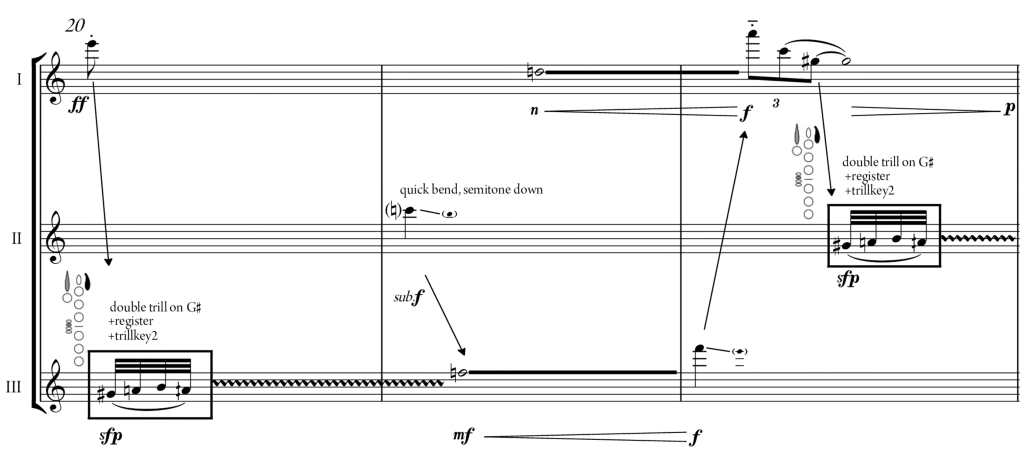
In this work I present a spectrum of “spontaneous composition.” On the more conservative side, we have what I call “general aleatory” as seen in the following examples:

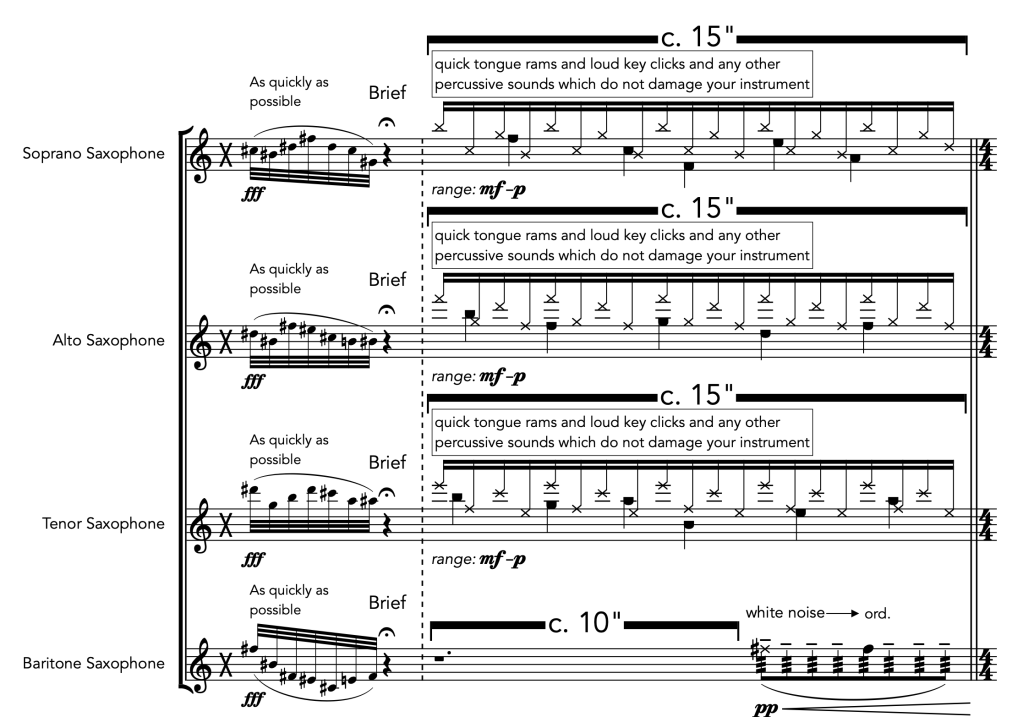
In the above two examples, the performer is in charge of making relatively small choices within the confines of a given period of time. The basic idea of this type of spontaneous composition is “do x until y.” x is limited in its complexity and length and must be easily memorize-able in order to allow the performer to keep it going without much thought. The y is perhaps the most defeating element of this type of spontaneous composition. Instead of focusing on making the material x into something expressive and musical, the performer has to instead focus their mental energy into keeping an eye open for y. This can be helped in two ways, one is adequate rehearsal time so that the performers integrate the discrete signal y into their head enough to respond to it without even thinking, and the other is by having a hand signal y (normally given by a conductor, meaning this type of y is reserved generally for large ensemble works). The one choice left up to the performers is the exact tempo, although general guidelines such as “quick” (ex. 2) or the flurry of headless stems (ex. 1) are included to give a sense of the intended texture. Nearly nothing is left to chance here, and it is all in the service of the creation of a texture.
In the two examples, I’ve kept this kind of spontaneous composition to the margins, meaning it is always either a momentary effect or subservient to a more important line. Many works of contemporary music will stop here with their integration of spontaneous composition into their works, slapping a box on whatever small figures they have created and dubbing it innovative.
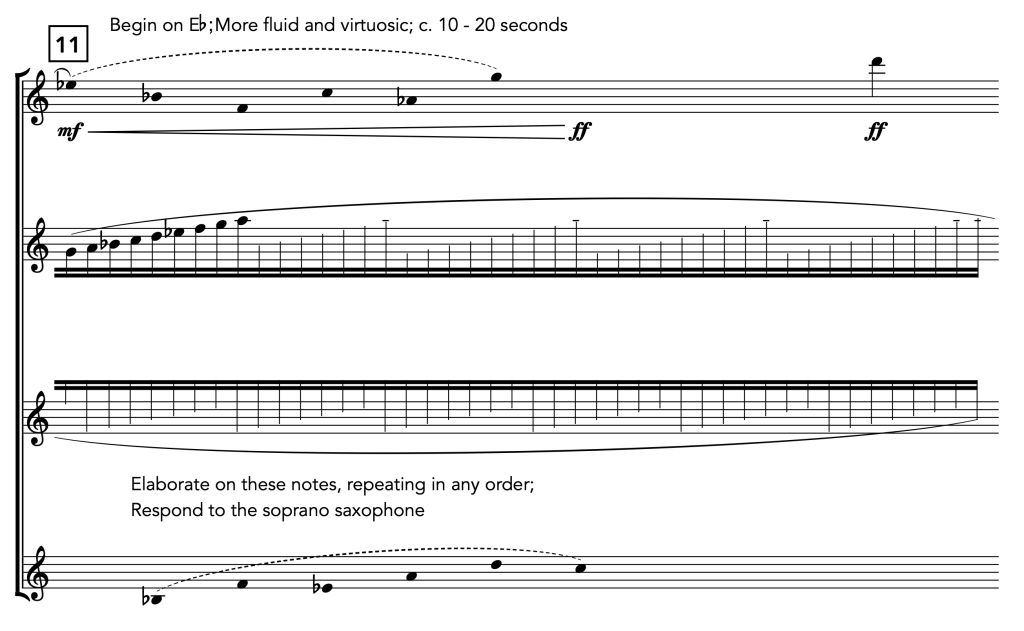
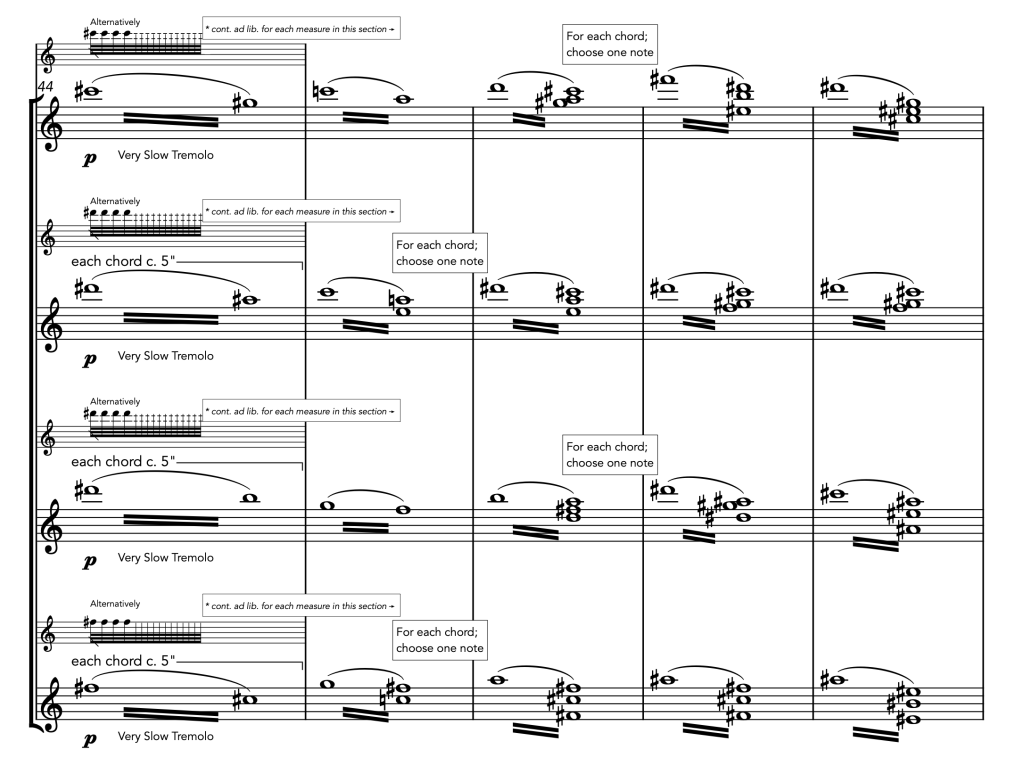
In examples 3 and 4 I developed the idea of “general aleatory” into something just slightly more divergent from typical performance practices. Instead of just the tempo of the gestures, now I am giving the limited decision of pitch and form to the performers. In example 3 I’ve given a large span of durations, allowing the performers to rely more on their in-the-moment intuitions and personal reads of the work to determine the length of the section, thus giving them control over the form. Furthermore, while the pitches are given, there is also the instruction to elaborate on the tones, allowing the performers to add their own pitches to the set. In example 4, I’ve included alternate paths of music in ossias above each instrument (they are allowed to play either the tremolo or the single pitch with each measure), while the pitches are semi-dictated via an instruction to “choose one note” out of the chords in the second half of the tremolo.
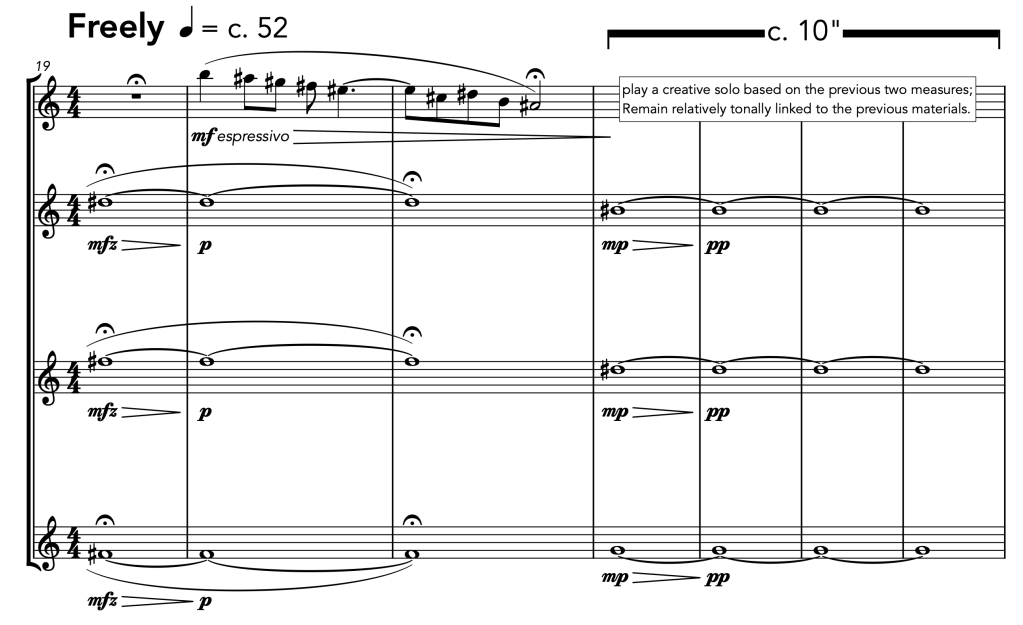
All the way on the other end of the spectrum away from “general aleatory” we have what I call “real improvisation.” This was more or less what I had in mind the first time someone told me about the concept of “box notation” – the composer or conductor or even the rest of the ensemble just sort of letting go of one player who plays something raw and from the heart. The soprano saxophone is given an approximate duration and a “seed melody” from which to develop the solo, but otherwise given full control over what happens in this moment musically.
In a way, this moment was the “inevitable conclusion” of the other ideas I developed throughout the work. As such I tread lightly when approaching this moment, expecting it could easily just fall flat on its face and not work particularly well. Because of this, I only included two such moments with “real improvisation” in this work (and in the middle movement, where not a lot of other freaky stuff is going on that might take the attention of the performers). Much to my surprise, this is perhaps the most beautiful moment of the entire piece, and exists as the sort of expressive heart of the work.
A recording is coming soon! We did a long session back in April where the performers utterly blew out their chops because as a whole the piece is WAY too much of a marathon for its own good. I’m looking forward to sharing the recording, but for now, please take a look through the score below.

